The Old Sugar Mills & Plantations of PR, Part 3
As mentioned in my 2 previous posts, the area in South East PR was home to the last Sugarcane haciendas (plantations) and sugar mills.
If Guayama was the epicenter of this climatic chapter in PR’s history, then Arroyo was its ‘port of call’ on the coast. The commercial port at Aguirre Central did not come into being until the early 1930’s.
The ‘Welcome to Arroyo’ sign is a sculpture commemorating buccaneers of the sea.
Profiteering & smuggling were very much a part of its past!
As per the last post, we were there on a Thursday. It was hot and humid but there was a little bit of a breeze down by the sea. That did take the edge off the +90F heat.
Arroyo is a sleepy little town about 1/4 the size of Guayama. It was formally founded on Christmas day, 1855, but was a Spanish settlement long before that. Its always been a popular rest stop on the way to other destinations. However, Arroyo has a checkered past. Legend has it, that a ship wrecked individual washed up at Arroyo. They thought he had Cholera so they tossed him back into the sea. At the time, Cholera was widespread across the island. Another story claims a local known for his generosity, came down with Bubonic plague and was reportedly burned alive to protect its citizens. It was known back then as ‘Pueblo Ingrato’. These events have haunted Arroyo ever since. Hence its desire to clean up its reputation and declare itself, Pueblo Grato.
Believe it or not– Samuel Morse set up the first telegraph line on the island and all of Latin America, here in Arroyo. It stretched from Hacienda La Enriqueta (his daughter’s home), a sugarcane plantation, down to the docks at Arroyo. Morse did this while visiting his daughter and son-in-law in 1859.
This event inspired the government of PR to run telegraph lines connecting the rest of the island and was completed in the early 1870’s. Well before the Spanish-American War of 1898.
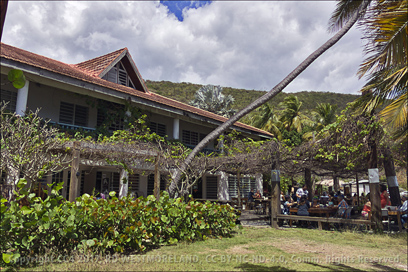
We drove on down to the boat harbor in hopes of scoring a couple of Cervezas (beers) to cool us off. As luck would have it, there were several bars to check out. We stopped at ‘Bar El Barco’. It had a juke box in the corner blaring out up-beat Latin ballads. The Puerto Rican gal behind the bar spoke perfect English and seemed to be amused by our presence. With all the doors swung wide open, there was a nice breeze through the place.
The mid afternoon sun is quite harsh. The locals always avoid this time of day.
As a gringo (well, Scurvy Dog) in Paradise, it was a perfect time to shoot. I had the place to myself.
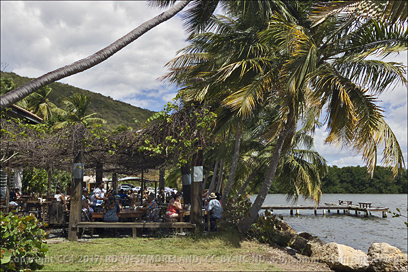
The small sheltered harbor across from the bar looks like it’s slowly filling in with sand. Thanx to Global Warming, that may not be much of a problem. Arrg!!! As can be seen in the wide shot, small fishing boats still tie up here. It was a beautiful spot. 
There were signs of serious infrastructure improvements going on. A series of cement kiosks were being built along the boardwalk, including a rather interesting cement sculpture down at the far end. I guess this area gets more traffic in the evenings.
Arroyo’s beaches are very popular and draw large crowds on the weekends too.
From here, we headed up Morse Street a couple of blocks to the newly renovated U.S. Customs Office. It’s a museum in its own right, Museo Antigua Aduana. We were somewhat pressed for time, but I did stop and take the opportunity to shoot it.
It has a gorgeous facade around the front door, an interesting steel sculpture in the front yard and a very nicely maintained private garden in the back. The sculpture looked like a water fountain of sorts, but was not turned on. Just inside the entrance are several old black and white photos from Arroyo’s past.
A few more blocks on up Morse was Arroyo’s central Plaza. It was on the smallish side. There was a central water feature with a couple of bronze plaques. One of them was dedicated to Morse by the Daughters of the American Revolution. Go figure. Several large trees with park benches rounds out the Plaza.
On an adjacent corner is a most magnificent Catholic church. In fact, the grounds of the church are larger than the city’s Plaza. The small gardens out front were beautifully maintained. Services are held here weekly.
As we headed out of town, Morse Street becomes Hwy 178. We took this to La Valentina, then a right onto ‘Camino Vecinal’ which turns into Calle Cangrejos (street). I spotted yet another abandoned sugarcane mill so I stopped to check it out. Great shots!!
Further on down, we hit the open beaches. No facilities, but perfect for a picnic or bar-b-que. By this time, it was starting to rain. We did run on down to the guard shack just outside Faro Punta de las Figuras (lighthouse). Since the weather had gone bad, we decided to turn around and go home. There is a beach resort located a little further up the road. I’ll have to come back for that another time.
Remnants of the last narrow gauge railroad on the island can be found if you know where to look.
All the commercial travel guides make reference to the ‘Tren del Sur de Arroyo’ sugarcane train tour (established in 1984). They also state that its currently suspended for ‘service’. I did get a peek at the facility and it looks like it’s been abandoned since it was shut down in 2005. Grass was growing in the parking lot and shrubs were taking over. One of the little narrow gauge diesel electric Plymouth switcher engines is on display outside the fence.
It was raining pretty hard by the time we got there (on our way back home) so I was limited with what I could do. You can just barely make out the train engine on the far right of the panoramic shot. Of the many photos I saw online from folks who did get to ride the train, it looked kind of ‘rugged’.

Not the ‘Six Flags” ride most folks are familiar with. It still seems like something worth resurrecting, if only on a smaller scale. Current plans are in play by the Instituto de Cultura Puertorriqueño to do just that. I’ll update as I find out more.
Unfortunately things went bad after we hit the highway on the other side of Guayama.
The Isuzu shredded a fan belt, over heated and blew a hose.
We were stranded on the side of the road until I flagged down a cop. He called a ‘Grua’ (tow truck) for us. It showed up about 40 minutes later. All together, we lost 2 hours on the side of the road. The operator was a real nice kid in his late 20’s. He was driving an old Chevy wrecker from the late ’60’s. A real clunker. The thought of a tow truck, towing a tow truck crossed my mind. It took another hour to get home from there. It was a little after 8PM by the time we pulled into the driveway. The tow set me back a $100. I had all three fan belts replaced for a total of $60.
Cramming two towns into one trip was a bit much.
I plan to come back to Arroyo for a 2nd pass at the boat harbor, beaches, lighthouse, museum and abandoned sugar processing facilities. Whew! There is plenty to see if you make the time.
ARRGGG!!!!!
My Name is Earl: This post was made early on Monday, ahead of the the impending arrival of Hurricane Earl. It should pass well North of San Juan so us folks on the South coast are pretty safe. That said, the power goes out in Puerto Rico on a weekly, almost daily basis (as does the water). I anticipate it going off any time. Internet service will be sporadic at best. Things should be back to normal by the end of the week. The Scurvy Dog, Arrg!
The Old Sugar Mills & Plantations of PR, Part 2
As mentioned in my last post, the area in South East PR was home to the last Sugarcane haciendas (plantations) and sugar mills. This is evident by the numerous red brick structures still standing from its distant past.
Guayama was the epicenter of this climatic chapter in Puerto Rico’s history.
Guayama as a settlement dates to before its founding in 1736 and boasted no less than 200 houses, a church and plaza by 1776. Guayama was also involved in the Spanish American War of 1898. Two battles were fought here, one in Guayama (August 5, 1898) and one North of town (August 9, 1898) as part of a campaign to move on Cayey, then on to San Juan. The war ended before that happened.
The nickname comes from the fact that African folklore is still celebrated today. This must not be confused with ‘black magic’ or Haitian rituals. There is a week long festival in March, the colorful Brujo Carnival.
There are several other fairs to see in Guayama, but the Dulce Sueño Fair is high on the local’s list. A celebration to honor the esteemed Paso Fino horse. I’ve seen a couple of these smaller horses out where I live. They are of Spanish origin and brought to Puerto Rico hundreds of years ago, however the Paso Fino is unique to Puerto Rico as its a mix of 3 specific breeds. A subject I will explore in the future.
The Rise and Fall of Sugar as King–
Sugarcane was grown on the island from the earliest days (using slave labor), but took off around 1830. Contraband trade with the US in sugar and molasses can be traced to before this date. Spain realized it could not control this illicit trade so in 1815, they sanctioned formal trade with the colonies. This opened the door for Cuba too. Slave labor, then cheap, unregulated labor after the US assumed control of PR drove the sugar industry. It was not until PR gained it’s “Commonwealth” status that the minimum wage came to bear.
Back then, the cultivation of sugarcane required burning the fields to rid the cane of leaves. Then it was cut down by hand with machetes. That was followed by crushing it in small local mills. Water and steam driven mills did not come into play until late in the 19th century.
Very labor intensive to say the least.
All agriculture fell into serious decline in PR as of “Operation Bootstrap” (1940’s) which encouraged manufacture and pharmaceutical development through a series of heavy tax incentives.
Sugar could not compete with the wages paid to ‘factory workers’ (as meager as they were by US standards) so the sugar industry relocated to Cuba and then to the Dominican Republic. It was all downhill for sugar by the end of the 1940’s.
Today, ALL of the sugar used
to make Puerto Rican RUM
comes from the DR, but since
it’s distilled and bottled here,
they don’t have to divulge
that little tidbit of info.
Arrg!!!!
The 21st Century–
Greater Guayama is typical of most Puerto Rican towns it’s size (about 44,000 per 2000 census).
Their economy has adjusted with the times and supports it’s self with some agriculture, livestock and some commercial manufacture including pharmaceuticals.
Jobos Bay National Estuarine Research Reserve (2,883 acres) and Aguirre fall within Guayama’s jurisdiction (pronounced Hobo). Jobo is an indigenous fruit bearing tree similar to Mangoes. The Estuary skirts the Eastern edge of Aguirre Central covered in my last post. These Mangrove forests are a good place to go if you are scouting for birds. Manatee can be spotted in the area too. I will make it back to this spot for more shots.
I took Hwy 53 off Hwy 52 to get to Guayama. It was a straight shot without any issues. Worth noting, at that turnoff is a giant steel structure that resembles a bobsled run.
Its actually a huge tail fin sculpture for a grove of palms laid out on the ground like a big airplane. You can easily make it out from the GoogleMap image. We drove through it several times not knowing what it was supposed to be.
We were there on a Thursday. It was hot and humid with little air circulation. As hot as being in Ponce. In fact, the South side of the island, down by the coast is almost always hot. Beautiful, but hot. We always pack a small cooler and I was real glad we did today. I had done a pretty thorough job with GoogleMaps this time so I basically knew where I wanted to go.
Our first stop was the cool sculptured Welcome sign to Guayama. A strange looking thing. But I liked it.. very whimsical.
Then we proceeded to a set of ruins right off the highway. The access to this site was very limited. It was over grown well over my head. I did manage to score a few good shots from the old wind mill used to grind up sugarcane. I tried to hike over to the nearby syrup processor (square chimney), but the growth was simply too thick. I could not see more than a few feet in front of me.
A second set of ruins we visited were back up the road from here. These were from the Hacienda Azucarera Vives. The grounds had a formal gate, but was not locked. The site was obviously being kept clear by the city. I spent a good hour here shooting the remains and plan to come back with better gear later. A small tree growing out of the top of the old mill was like icing on the cake. Most fantastic! I was melting at this point and downed an iced coffee.
From there, we headed on into ‘old town’ where the main Plaza was. I stopped off at the ‘Totem” first for a few shots. Up close, it’s rather phallic looking. A beautifully cut piece of steel sculpture dedicated to Govenor Sila Maria Calderon (2001– 2004) for urban renewal work done in Guayama. From this vantage point, you can see the Hacienda Azucarera Vives on the distant hill.
The central Plaza features a very large water fountain (wish it had been on) surrounded by many trees providing shade from the noonday sun.
Did I mention it was HOT?
As time went on, the haze got thicker and thicker. Off the Plaza was the Mayors office (being remodeled), the Catholic church, an old movie theater converted into municipal offices,
a Methodist church built in 1902, a local Christian radio station, several stores and a Museum. The churches were beautiful. The Catholic church, Iglesia San Antonio de Padua has a clock face painted on one tower set at 11:30 AM. The exact time it was originally baptized. It is the only Catholic church on the island built in the classic neoromantic style. Though I did not go into the museum at Casa Cautino, it is a striking example of late 19th century Creole style architecture. Absolutely stunning.
After this round of shots, we ducked into REX CREAM for something to cool us off. It’s also right off the Plaza, on the corner. There was just barely room to stand, but it was worth it. ALL of the travel guides make reference to this place. Flavors are seasonal and more resembles sherbet in taste and texture. I had the Tamarindo and me 1st Mate had Pistachio. Arrg! Both were very good. The cafe next door is part of REX Cream so there is much more food and refreshments to be had.
The Plaza in Guayama was well worth the trip.
For Guayama and REX CREAM
Our trip continues on to Arroyo, but I’ll save that for me next post… Arrg…
One of my favorite photo subjects is ruins and old run-down industrial buildings. Great subjects for fine art images. Seeing history with my own eyes is just too cool. To that end, I plan to spend several posts covering the sugar, rum and railroad history of PR. This is the first installment in that effort.
I’ve spent a lot of time researching sugar production and the rum (ron/Spanish) distilleries of Puerto Rico.
Coffee, tobacco and sugar cane were the primary income crops from the time the island was ‘settled’ until well into the 20th century.
Slavery, followed by cheap, unorganized labor was the driving force behind all production. As labor costs increased, the Spanish and then American interests proceeded to mechanize where they could. Some plantations were still using ox drawn carts to transport the cane from the fields, up through the late 1940’s.
Prior to the interstate highways, there was a rail service that circled almost the entire island. What’s more, lots of plantations (haciendas) would have their own narrow gauge trains working the fields and local sugar mills. There were many of these small sugar mills spread out all over PR.
As of today, you can still see their red brick, square chimneys dotting the landscape.
You can’t miss ‘em since they stand 40 to 50 feet tall. Most are in some state of decay. A few have been turned into historical monuments to a bygone era like the one at the Botanical Gardens in Caguas.
The island wide public train service came to a halt in 1951. Local narrow gauge sugar cane trains ended in 1958. Arroyo ran a small train for tourists from 1984 to 2005.
It was a guided 50 minute run around the last surviving sugar hacienda. It closed for restoration and never reopened, but supposedly, the Department of the Interior has picked up the project. I’ll be looking into that more in the near future.
In all fairness, there is a pair of diesel locomotives doing service at the Port of Ponce. They are used strictly for moving tank cars in support of the pharmaceutical biz. Otherwise, there is no working train service left. Too bad too! Tren Urbano in San Juan don’t count.
RUM.. ARRGGG!!!
Early Rum distillation in PR can be tracked back to the 16th century. It started out as a domestic product not suitable for western palates, but it did not take long before they were exporting a refined, filtered product like we enjoy today.
Believe it or not, ExPats from Ireland were instrumental in expanding the sugar and rum industries and initiating the cultivation of tobacco. Between trying to avoid service in the “Queen’s Navy” circa 1585 (and forward) and the Potato Famine of the 1840’s, many Irishmen have settled here.
In 1823, 2 Irish brothers brought the first steam driven sugar mill to Puerto Rico and set up shop near Ponce on their own plantation. Bayamon, outside of San Juan has a community (urbanization) called Irlanda Heights ( Ireland Heights). Yes, St. Patrick’s Day is celebrated in many places. Luquillo hosts a St. Patty’s Day parade as well. Who knew?
I’ll be elaborating on sugar, rum and the RR’s in future posts.
Aguirre, a place lost to a Bygone Era
Because the area around Aguirre was the last area to suspend sugar production (1993), I started my field work there. It’s off Hwy 3, east of Salinas and west of Guayama. It’s technically a barrio of Salinas so no plaza or mayor’s office.
Around Aguirre, banana and papaya groves stand where sugarcane once grew.
Not quite a ghost town, but close. Its a small community of only a couple hundred folks. The Post Office stands next door to the defunct mill. A sign warning about Asbestos exposure was posted in the parking lot. I did not venture into those ruins… maybe at a later date.
Most of the homes as well as the business structures date from the early 1920’s There was evidence of new homes built of cement so there is some activity going on. There is a golf course there, but I did not check it out. While driving around, I found an old abandoned 2 story cement hotel and the tiny railroad depot of Aguirre. Both were dated 1926.
The little RR freight office was overgrown with grass well over my head, but that did not stop me from checking it out. The only posted warning signs were about trashing it or shooting off guns. Someone had gone to a lot of trouble to plant dozens and dozens of small trees out in front of the place.
I worked my way through the grass to get inside for a shot. The stairs to the 2nd floor were rotted out so I passed on that. Maybe next time. It was easy to see where the loading dock sat in reference to the freight doors. It must have been a busy little place in the ’30’s and ’40’s.
Back tracking to the abandoned hotel, I was able to walk and shoot the entire structure. It must have been quite a grand place as well. The 2nd floor had a commanding view of the old mill and the Caribbean Sea beyond. The structure sat on a slight rise giving it a major sense of presence. Employee’s quarters could be seen off the back along with a giant well. Just off the hotel was what appeared to be a restaurant or club connected via a cement walkway. Also in a major state of decay.
I will come back to Aguirre with ‘other’ gear another time. The photo possibilities are fantastic.
Bahia Jobos
There is a nature preserve off the coast, near Aguirre so we proceeded to check it out. The road quickly turned into a rutted mess with the locals packed around several seafood shacks and restaurants. I wanted to check one out, but it was just too crowded for me. Parking would have been a pain. The end of the road came sooner than I was expecting with a chain strung across it. All of this is right at the water’s edge. Many homes, some quite expensive, lined the high side of the road. We made our way back to Salinas and on home to Coamo from there.
Arroyo is next on the list to check out.
I also located the Speedway in Salinas where they run stock car drag races and oval track competition. It is open on Sundays, Mondays and Wednesdays. I look forward to checking it out as well.